Mā te rongo, ka mōhio. Mā te mōhio, ka mārama. Mā te mārama, ka mātatau. Mā te mātatau, ka ora.
Whakataukī
Tēnā koutou katoa. Kāhore he piringa i tua atu i te piringa o ngā tohunga matua. Ki ngā pou whakairo o te wheiao, ki ngā kaikōrero o te ao tūroa, tēnā koutou. Ki a rātou kua hoki atu ki te kāinga tūturu, ki te pō nui, moe mai ra, okioki ai. Tenei te reo mihi e rere atu ana ki ngā kaitiaki o tēnei taonga, ā, ki ngā pūkenga i whāngai mai i te mātauranga ki ahau. Nau mai, haere mai ki tēnei tūāpapa whakairo, tūāpapa toi e whakahonore ana i ngā matua tohunga o taku nei rārangi whakapapa toi.
Ngā Tohunga Whakairo
Master Teachers of My Lineage
Roderick & Joan Gray
Ngā Matua / My Parents & Primary Foundations
Ngāti Raukawa ki te TongaNgāti KahungunuTahiti (Mauatua Lineage)Pitcairn Island
The First Teachers of History, Customary Art, and Identity
Maternal Lineage
Long before I ever entered a formal carving school, the true genesis of my artistry began at home with my parents, Roderick and Joan Gray. They are my absolute primary masters. My mother, Joan Gray, carries the profound spiritual and artistic bloodline of the Pacific, being a direct descendant of the Mauatua line in Tahiti. She is a master practitioner in her own right—an expert weaver, painter, and practitioner of Mahi Rongoā (traditional healing). Through her hands, she introduced me to the rhythm of creation, raw material connection, and the healing power of visual form.
Paternal Historian
My father, Roderick Gray, was an elite master of Whakapapa (genealogy) and Pūrākau (creation stories), serving as a profound historian of most Iwi and Hapū of Aotearoa. As the eldest son in a family of five, my father occupied a unique, monumental space in my life; he was not just a parent, but stepped into the role of an older brother figure who fiercely shaped me into the man and practitioner I am today. He carved the ancient histories into my mind through words long before I ever carved them into timber with steel.
Inherited Foundation
Together, my parents fused Pacific structural artistry with deep Aotearoa historical truth. They held the steady space that allowed me to transition from a naive youth into a disciplined artist. But the shaping of my being did not rest on my parents alone—it was carried by my wider Whānau. My Uncles, Aunties, and Cousins surrounded me, each contributing their own mātauranga, laughter, and lived example to the soil I grew from. Everything I create is an extension of the knowledge they all held and passed down. By honoring Roderick and Joan Gray at the absolute apex of my lineage, I acknowledge that my hands may shape the designs, but it was their combined mastery, and the collective mana of my Whānau, that shaped the soul of the artist holding the tool.
Louis (Lou) Te Kouarehua Kereopa
Tohunga Whakairo / Master Carver
Ngāti TūwharetoaNgāti Maniapoto
Graduate of the New Zealand Māori Arts and Crafts Institute (1972)
Lineage Teacher
Hone Taiapa
Tohunga Whakairo / Master Carver
Ngāti Porou
Institutional Legacy
Before formal tertiary art faculties existed in Porirua, Tohunga Whakairo Matua Lou Kereopa spearheaded regional whakairo training, directing the independent Maraeroa Carving School at Maraeroa Marae in Waitangirua. In 1986, he joined Parumoana Community College (now Whitireia New Zealand) as a foundational tutor, hand-carving the historic opening plaque unveiled by Governor-General Sir Paul Reeves. By 1987, his intensive curriculum helped anchor the polytechnic's new Certificate in Craft Design, producing an inaugural class of carvers that included world-renowned master artists like Rangi Kipa. Through this direct, documented lineage, my contemporary practice inherits the technical and philosophical parameters established by these pioneers.
My Poutama Journey — 1994
In 1994, my formal artistic lineage crystallized when I entered the Poutama program at Whitireia Polytechnic, learning directly under Tohunga Whakairo Matua Lou Kereopa. Poutama was a transformative space where the boundaries of traditional whakairo rākau (wood carving) met mixed-media art. It was here that I picked up a chisel for the very first time, carving my first raw, tentative lines of haehae (parallel grooved cuts). Looking back at those initial lines today, they stand as a powerful reminder of where every practitioner must begin. While they lacked the refined technique of a seasoned carver, I understand now that practice makes perfect, and we all must start somewhere.
Reflections of Youth
Matua Lou imparted wisdom that went deeper than the physical craft of woodworking. As a Tohunga Whakairo, he anchored our hands in the pūrākau (creation stories), tikanga (customs), and kawa (protocols) that govern the sacred art of whakairo. As a young student in 1994, navigating the outside world meant my mind sometimes wandered, easily distracted by the vibrant, outside influences facing youth at the time. Harking back to that era, I realize Matua Lou was not just teaching us how to shape material—he was holding a steady, patient space for us as we grew. The seeds he planted took root in their own time, turning early struggles with focus into the bedrock of my contemporary creative discipline, grounding my artistic voice as a practitioner of Ngāti Raukawa ki te Tonga and Ngāti Kahungunu descent.
Rangi Kipa
Tohunga Whakairo / Multidisciplinary Master Artist
Te Āti AwaTaranaki IwiNgāti MutungaNgāti Tama
Graduate of Maraeroa Carving School (1986), Master of Māori Visual Arts (Massey University, 2006), NZ Arts Foundation Laureate (2021)
Lineage Teacher
Matua Lou Kereopa
Tohunga Whakairo / Master Carver
Ngāti Tūwharetoa / Ngāti Maniapoto
Contemporary Frontier
Where Matua Lou Kereopa provided the raw, anchoring foundation of my whakairo journey, studying under Tohunga Whakairo Rangi Kipa circa 1995 within the Poutama program at Whitireia Polytechnic blew the parameters wide open. As an elite graduate of Matua Lou's early Maraeroa class, Rangi represents the perfect continuation of my lineage—bringing the discipline of the old carving school into the fearless arena of contemporary global art. His practice is renowned for challenging conventions by utilizing modern, non-traditional materials alongside sacred ancestral elements. Through his guidance, I learned that Māori design is not a static artifact trapped in history, but a living, breathing language that must aggressively evolve to assert our modern identity.
Art & Discipline
Learning from Rangi Kipa meant engaging with art as a profound social tool for decolonisation and cultural reclamation. Most importantly, Rangi taught me to stand strong and unconditionally honor the status of an artist. He demonstrated that holding this mantle requires the application of strict, rigorous discipline in both thought and execution. He shifted my focus from merely making objects to understanding the kōrerorero (narratives) and intellectual frameworks bound within our visual systems. Under his wing, I understood how to take the raw lines carved in my youth and refine them through uncompromising professional discipline into conceptually sharp, contemporary Māori design systems.
Hēmi Te Peeti
Tohunga Whakairo / Master Carver, Kaita & Art Director
Ngāti Raukawa Te Au ki te Tonga (Manawatū/Horowhenua region)Ngāti Rangiwewehi (Rotorua area)Te Āti Haunui-a-Pāpārangi (Whanganui region)Ngāi Tūhoe (Te Urewera region)
Former Art Director & Whakairo Tutor at Whitireia Community Polytechnic (1996-2002)
Master Profile
Hēmi Te Peeti is a highly respected Tohunga Whakairo, kaita (traditional tattooist), and Māori arts consultant who has dedicated his life to the preservation and expansion of traditional custom arts. Born into an elite lineage of active wood carvers and ancestral practitioners on both his mother's and father's sides, Hēmi began carving at the age of six under the direct tutelage of his uncles. Highly regarded for his work across marae meeting houses throughout Aotearoa and his national advocacy for traditional tapping skin techniques (uhi matarau), his practice balances deep ancestral history with community education.
Narrative Weaving
Studying under Tohunga Whakairo Hēmi Te Peeti within the Poutama program at Whitireia completely refocused how I conceptualize visual art. The guidance I received from Hēmi was completely rooted in theory, serving as an intellectual awakening that was absolutely vital to the growth of my artistry. He shifted my understanding of design from a purely physical or structural execution into a deeply cognitive, communicative act. He meticulously trained me to intentionally weave complex narratives, whakataukī (proverbs), and distinct tribal sayings directly into the linework, negative spaces, and overarching geometry of my work. Through his theoretical frameworks, I learned that a true artist conceives the entire story long before the chisel or brush touches the material, ensuring every layout is a vessel for recording indigenous history.
The Creative Cycle
Idolizing a rigorous approach, Hēmi provided an invaluable professional blueprint for navigating the mental demands of creation. He walked me through a rigid, traditional yet contemporary cycle of Observation, Debate, and Resolution. He taught me never to rush the genesis of a design. Instead, a practitioner must first sit back to observe the canvas and environment (titiro), aggressively debate the conceptual and cultural validity of the composition (whakawhiti kōrero), and only apply the final chisel mark or brush stroke once absolute spiritual and technical resolution (whakatau) is reached.
Te Warihi (Frazer) Taiapa
Tohunga / Kaumatua & Cultivation Master
Ngāti Porou
Inheritor of the Pine and Hōne Taiapa ancestral lineage
Holistic Frontier
Studying under Matua Frazer Taiapa circa 2000–2004 within the immersive academic environment of Te Wānanga o Raukawa in Ōtaki brought my journey full circle, grounding my design practice firmly in mana motuhake (self-determination) and holistic well-being. Matua Frazer opened my eyes to the truth that Māori design does not begin on a canvas or a piece of timber; it begins in how we tend to our roots, our communities, and our environment. His teachings blended the boundaries of structural art with the ancestral science of cultivation, demonstrating that growing kai (food), growing people, and growing minds are all expressions of the exact same creative system. He taught me to look at the land as a mirror for my design work, ensuring that every project I create serves to feed and nurture the spirit of the people it belongs to.
Mastery of Form
Crucially, Matua Frazer provided me with a profound leap in my physical handling of three-dimensional form, directly passing down the legendary carving philosophies of his Ngāti Porou lineage. He explicitly taught me how to see and carve the profound fullness and roundness required for authentic wall panels (poupou) and ancestral human figures (tekoteko). Under his watchful eye at the Ōtaki campus, I stopped treating wood as a two-dimensional surface to be flatly engraved. Instead, I learned how to release the breathing volume and weight of our ancestors from the timber, ensuring that every curve of a tekoteko torso or shoulder on a poupou panel stands with physical power, presence, and structural vitality.
Tākuta Ferris Jnr
Pouako / Toi Māori Lecturer & Master Practitioner
Ngāi TahuNgāti KuiaNgāti KahungunuNgāti Porou
Bachelor of Māori Art & Master of Mātauranga Māori (Te Wānanga o Raukawa)
Technical Refinement
Studying under Tākuta Ferris Jnr between 2004 and 2007 at Te Wānanga o Raukawa in Ōtaki marked a significant shift toward technical mastery and strategic refinement in my practice. Tākuta challenged me to elevate the execution of my linework, transitioning my skills from structural creation to an elite standard of precision. His mentorship focused heavily on patience and precision, showing me how to treat every surface with an uncompromising level of finish that respects the inherent prestige of the art form.
Methodology of the Grain
The defining breakthrough of this era was mastering the methodology of reading and following the natural grain of the wood. Tākuta taught me to stop forcing the tool against the material. Instead, I learned to listen to the timber, identifying the direction of its growth rings and organic density before making a single cut. This approach taught me that true refinement is an act of collaboration between the carver and the wood. By flowing with the grain, the structural integrity of the design is preserved, ensuring the final piece reflects both technical excellence and ancestral truth.
Hēmi Tahupārae
Tohunga Whakairo / Master Carver & Pou Kaiako
Ngāti RaukawaTe Āti Awa
Long-serving Whakairo Tutor & Course Director at Te Wānanga o Raukawa
Collaborative Refinement
Studying alongside Tākuta Ferris Jnr under the direct guidance of Tohunga Whakairo Hēmi Tahupārae between 2004 and 2007 completely revolutionized my approach to three-dimensional surface aesthetics. Hēmi possessed a rare, elite eye for surface layout and design execution. He pushed me to dissect the precise regional variations of ancestral wall panels (poupou) and peak gable figures (tekoteko), teaching me how to treat the wood not just with technical correctness, but with an elevated standard of sculptural refinery that demands presence.
Surface Variations
Under Hēmi's watchful eye at the Ōtaki campus, my understanding of custom iconography deepened. We deeply explored the distinct technical boundaries that separate different tribal carving schools. He taught me how to alter cuts and modify surface design applications to accurately match the specific histories being carved into the timber, ensuring that my physical poupou and tekoteko works maintain true cultural accuracy while reaching an impeccable, crisp professional finish.
Karl Leonard
Pou Kaiako / Tohunga Raranga & Master Weaver
Te ArawaNgāti AwaNgāti Raukawa
Master of Māori Visual Arts (MMVA); First male elected to the national Māori weavers committee (Te Roopu Raranga Whatu o Aotearoa)
Surface Design
While learning Toi Whakairo under Tākuta Ferris Jnr and Hēmi Tahupārae between 2004 and 2007 at Te Wānanga o Raukawa, the presence of Pou Kaiako Karl Leonard was integral to my learning. Though Karl did not teach me carving, raranga, or kōwhaiwhai directly, his proximity as a master exponent who fluidly bridges the technical disciplines of kōwhaiwhai painting and raranga profoundly impacted my understanding of structural symmetry and custom design. He helped me see patterns not as passive decoration, but as mathematical, living systems where the relationship between negative and positive space must remain flawless.
Artistic Impact
Through Karl's presence and guidance, I came to appreciate how the flowing geometry of kōwhaiwhai scrollwork demands that lines retain a natural weight and momentum. His example dismantled the false barriers between different mediums, showing me that the same precision required to align a kōwhaiwhai scroll governs the structural strength of a physical carving. I am deeply humbled to have learned alongside a master who redefined the space in traditional woven and painted arts.
Diane Prince
Pou Kaiako / Multidisciplinary Master Artist & Weaver
NgāpuhiNgāti Whātua
Renowned contemporary artist, weaver, and long-serving Toi Māori lecturer
Narrative Artistry
Learning under the guidance of Diane Prince during my time at Te Wānanga o Raukawa infused my design practice with high-level conceptual freedom and political strength. Diane is a legendary figure in contemporary Māori art who famously utilizes traditional weaving structures as a fearless platform for storytelling and social commentary.
Artistic Impact
Diane taught me how to embed deep, layered messages within abstract and customary design layouts. She demonstrated how visual art serves as a tool for cultural preservation and an active extension of our sovereignty (tino rangatiratanga). Under her mentorship, I learned to look past the superficial aesthetic of a pattern and rigorously analyze the political, ancestral, and narrative weight it carries, ensuring my work stands with authentic conviction.
Sonia Snowden
Tohunga Raranga / Master Weaver & Tukutuku Expert
NgāpuhiNgāti WhātuaNgāti Hine
Te Waka Toi Ngā Tohu ā Tā Kingi Ihaka Award recipient (2019) for lifetime contribution to Māori arts
The Sacred Lattice
Although I did not train directly under Tohunga Raranga Sonia Snowden, her presence during my learning years at Te Wānanga o Raukawa was highly influential and a monumental privilege that redefined my approach to architectural surface arts. Sonia is widely revered as a national treasure in the revival of tukutuku panel construction and traditional material preparation.
Artistic Impact
Through her proximity and example, Sonia revealed the strict discipline of tukutuku design—showing how to count, map, and knot individual stitches with absolute consistency to form sacred lattice-work patterns like poutama and roimata toroa. Her presence extended beyond the artwork itself; she modeled a deep respect for the materials, demonstrating that the patience required to bind a panel mirrors the patience needed to anchor an individual's identity. Having her nearby as a local master remains an ongoing anchor for my creative discipline.
Pip Devonshire
Pou Kaiako / Master Weaver & Toi Māori Lecturer
Ngāti Raukawa ki te TongaNgāti Toa Rangatira
Creative New Zealand Te Waka Toi Award Winner; Graduate and Resident Tutor of Te Wānanga o Raukawa
Tribal Geometry
Learning from Pip Devonshire directly connected my training to the local landscape and the distinct tribal design parameters of the Kāpiti-Horowhenua region. Pip's mastery of customary raranga and tukutuku provided me with an invaluable structural education in pattern layout and spacing.
Artistic Impact
Pip taught me how to read the visual rhythm of traditional tukutuku panels, demonstrating how geometric sequences speak directly to the lineage and values of a specific wharenui. Her presence as a master who is local to my practice taught me the value of kaitiakitanga (guardianship) over our creative spaces. She modeled how an artist holds knowledge responsibly, ensuring it serves to strengthen the immediate community and future generations.
Elaine Bevan
Pou Kaiako / Master Weaver & Customary Arts Researcher
Ngāti Raukawa ki te TongaNgāti Toa Rangatira
Resident Master Weaver and Long-Serving Faculty Lecturer at Te Wānanga o Raukawa
Material & Form
Studying under Pou Kaiako Elaine Bevan completed the foundational makeup of my surface art education, grounding my hands in the rigorous protocols of traditional production and structural alignment. Elaine's expertise in historical weaving frameworks brought a profound level of authenticity to my training.
Artistic Impact
Elaine emphasized that a great design is only as strong as the foundational structure supporting it. She taught me how to maintain exact tension, calculate correct dimensions, and respect the ancient lineage of the patterns I was implementing. Her teachings remain a vital pillar of my contemporary practice, reminding me that every line we execute is a physical link to the masters who walked before us, right here on this whenua.
Further Inspirations
Beyond the direct master teachers who have formally guided my hands and tools, my practice is continually nourished by a vast ecosystem of creative excellence. While it is impossible to list every practitioner who has left an imprint on my journey, I wish to explicitly acknowledge a collective of master exponents whose vision, technical brilliance, and cultural conviction serve as constant beacons for my contemporary artistry:
Cliff Whiting
Tohunga Toi / Master Artist & Educator
Te Whānau-ā-Apanui
For his revolutionary ability to blend traditional whakairo structures with bold, contemporary mixed-media, and for pioneering the absolute freedom of Māori storytelling on a grand scale.
Lyonel Grant
Tohunga Whakairo / Master Sculptor
Ngāti Pikiao / Te Arawa
For his unmatched technical refinement, master engineering of form, and for pushing the boundaries of architectural whakairo into fearless, modern expressions.
Para Matchitt
Master Painter & Sculptor
Ngāti Porou / Te Whānau-ā-Apanui / Ngāti Kahungunu
For his powerful deconstruction of customary motifs into minimalist, striking graphic geometries that redefine the visual language of contemporary Māori design.
John Bevan Ford
Master Artist & Educator
Ngāti Raukawa ki te Tonga
As a revered local exponent, for his exquisite, liquid execution of kōwhaiwhai linework and for teaching us how to map ancestral landscapes directly onto paper and canvas.
Roi Toia
Tohunga Whakairo / Contemporary Master Sculptor
Ngāti Whakaue / Te Arawa
For his impeccable precision in finish and wood selection, and his brilliant ability to translate deep, esoteric Māori cosmology into hyper-refined, modern global sculptures.
Todd Couper
Master Sculptor & Carver
Ngāti Kahungunu
For his extraordinary mastery of fluid, organic movement within wood and bronze, demonstrating how traditional design lines can reach an elite level of silky, seamless refinement.
Graham Hoete (Mr G)
Multidisciplinary Visual Artist & Muralist
Ngāi Te Rangi / Ngāti Ranginui / Ngāti Awa
For his raw authenticity, fearless boundary-pushing in contemporary street art, and for showing how to boldly project the presence and mana of our people onto monumental public canvases.
Gordon Toi
Tohunga Whakairo & Kaita
Ngāti Whātua
For his uncompromising dedication to the revival of ancestral art forms, his raw strength in customary whakairo, and his pioneering vision in the reclaiming of mahi Tā Moko.
Ngāti Raukawa ki Te Tonga / Ngāti Manomano / Ngāti Huia ki Matau
For his dual mastery as a carver and weaver who beautifully balances customary foundations with contemporary Māori expression, and for demonstrating through his local exhibitions at Te Wānanga o Raukawa how an artist remains deeply accountable to the grounding and mana of their specific hapū.
For his lifelong immersion in traditional Māori arts, his sharp layout execution, and his masterful contemporary handling of dense rootstock kānuka to shape pristine traditional weaponry.
For more than two decades of stalwart whakairo tutoring at Te Wānanga o Raukawa, his masterclass in endurance and patience on the carving floor, and his deep guardianship of our local tribal design styles rooted in Ngāti Kapumanawawhiti and Ngāti Tūkorehe whenua.
Bill Doyle
Kaiwhakairo / Master Carver
Ngāti Raukawa
For his profound cultural execution and master craftsmanship—famously hand-carving New Zealand Rugby's iconic Tū Kōtahi Aotearoa trophy from ancient tōtara—and for serving as an enduring beacon of speed, fluid pattern design, and structural power within the Ōtaki carving community.
Wi Taepa (ONZM)
Tohunga Uku / Master Ceramicist & Sculptor
Ngāti Pikiao / Te Arawa / Te Āti Awa
For his legendary pioneering work in elevating the medium of clay (uku) within mātauranga Māori, his tactile hand-built approach to form, and for beautifully demonstrating how wood-carving aesthetics and deep whakapapa can be fluidly transposed onto entirely different organic surfaces to express the living spirit of our marae.
Owen Mapp (CNZM)
Tohunga Whakairo / Master Bone Carver & Educator
Pākehā (Fifth-generation Kiwi of Scottish / Shetland descent)
For his historical legacy as Aotearoa New Zealand's first contemporary professional bone carver, his deep archaeological devotion to reading the stories within raw material, and for teaching us through his decades of mentorship at Whitireia how miniature tactile taonga can be carved to hold immense spiritual weight and endure for a thousand years.
I stretch a special acknowledgment to my friends and my Whānau—those who have stood beside me, anchored my foundations, and shared the spaces of creation throughout my journey up to now. You know exactly who you are. The shared wānanga, the quiet midnight debates over design, and the collective energy of our people continue to sustain my creative fire. The works of all these visionaries remind me daily that Māori design is not static, but a living, aggressive force. I harken to their legacies whenever I sit before a blank canvas, ensuring my work continues to honor the high-level intellectual and visual parameters they fought to establish.
Featured Artwork
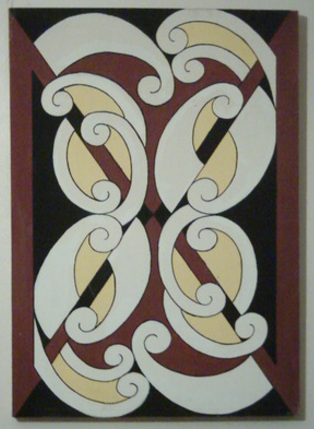
Whakapapa
Medium
Acrylic on canvas
Year
1994
Artist
Eria Gray
Guidance
Tohunga Whakairo Matua Lou Kereopa
This piece represents a massive milestone in my development. Under Matua Lou's guidance, we learned how to physically fashion a raw timber canvas frame and wrap the canvas tightly ourselves. This technical woodworking process directly birthed my very first acrylic painting, titled Whakapapa. The interlocking koru and kōwhaiwhai forms speak to the lineage, connection, and balance of knowledge passed down through generations. Created alongside a carved wooden pāua shell on a base during that same year, this painting is the physical genesis of my artistic path.
Ngā Papa Whakairo
Practice Boards & Early Foundations
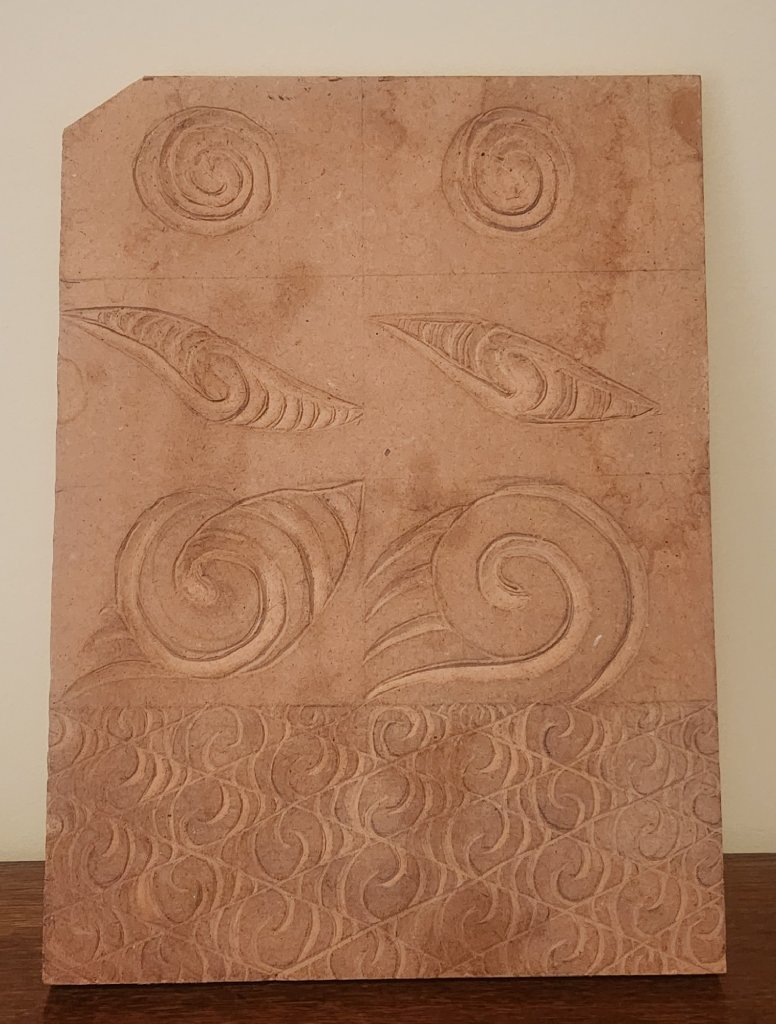
First Surface Pattern Practice Board
Medium
Whakairo rākau (Carved wood practice panel)
Year
1994
Created At
Poutama Program — Whitireia Polytechnic, Porirua
Guidance
Tohunga Whakairo Matua Lou Kereopa
The Genesis of the Chisel
This panel captures the literal genesis of my physical relationship with timber. Carved in 1994 under the watchful, patient eye of Matua Lou Kereopa, this board was my very first attempt to translate Māori design theory into physical wood cuts. Tracking from the simple early grids to concentric spirals, interlocking fluid lines, and a dense baseline of repetitive patterns, every gouge and groove represents a young artist searching for rhythm, pressure control, and depth.
Acknowledgements and Inspirations
I express a deeply humble acknowledgment to my master teachers for the immense time, guidance, and endless patience they held for me during my early learning years when my hands were still raw and my mind was finding its focus.
I formally acknowledge the numerous master carvers who carved out and set this sacred path long before me. It is upon their enduring legacy that I stand, and I am truly thankful for the visual and spiritual blueprint they set.
The Journey Over the Outcome
I display this raw practice piece deliberately to serve as a beacon of encouragement for others stepping onto their own path in Toi Māori. In a world that often only celebrates the flawless, hyper-refined finish of a seasoned master, it is vital to reveal the raw, unpolished origins where we all must begin. The superficial technical perfection of the final piece is secondary to the spiritual and mental journey of the practitioner. Every misstep, shallow cut, and rough edge on this timber holds the foundational DNA of the discipline, patience, and artistic voice I carry today.
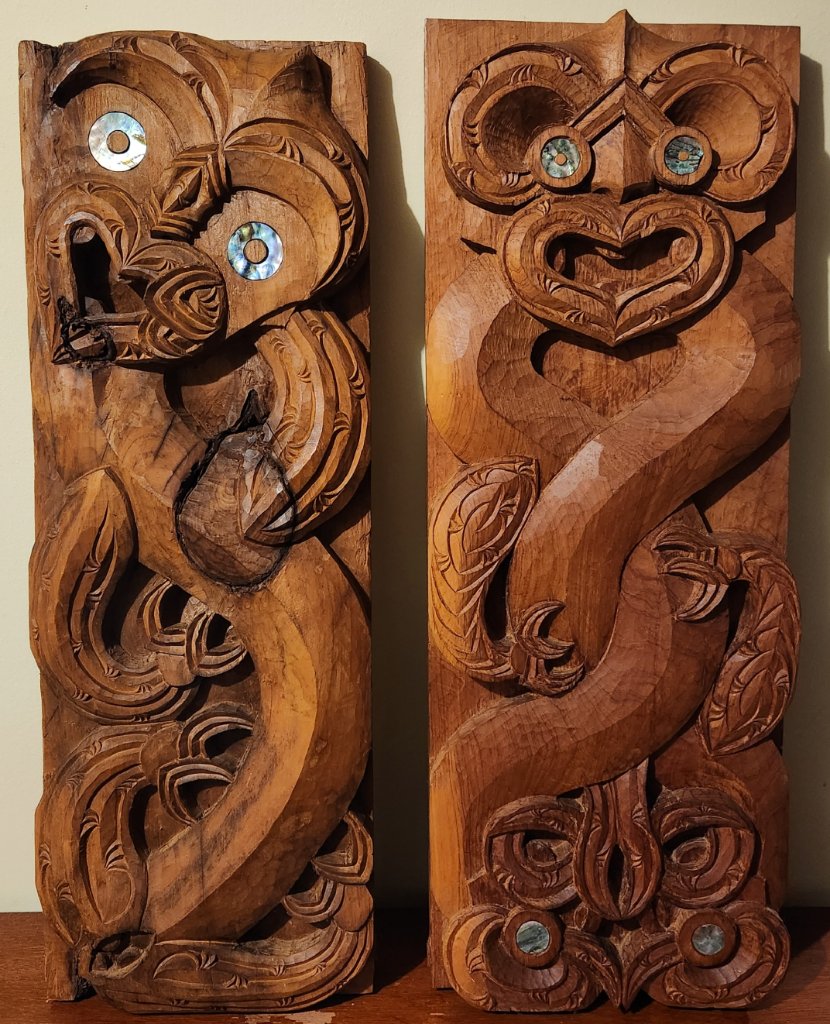
Regional Structural Studies: Poupou and Wheku
Medium
Whakairo rākau (Carved timber panels with pāua shell inlay)
Year
2004–2007
Created At
Te Wānanga o Raukawa, Ōtaki
Guidance
Tohunga Whakairo Hēmi Tahupārae & Te Warihi (Frazer) Taiapa
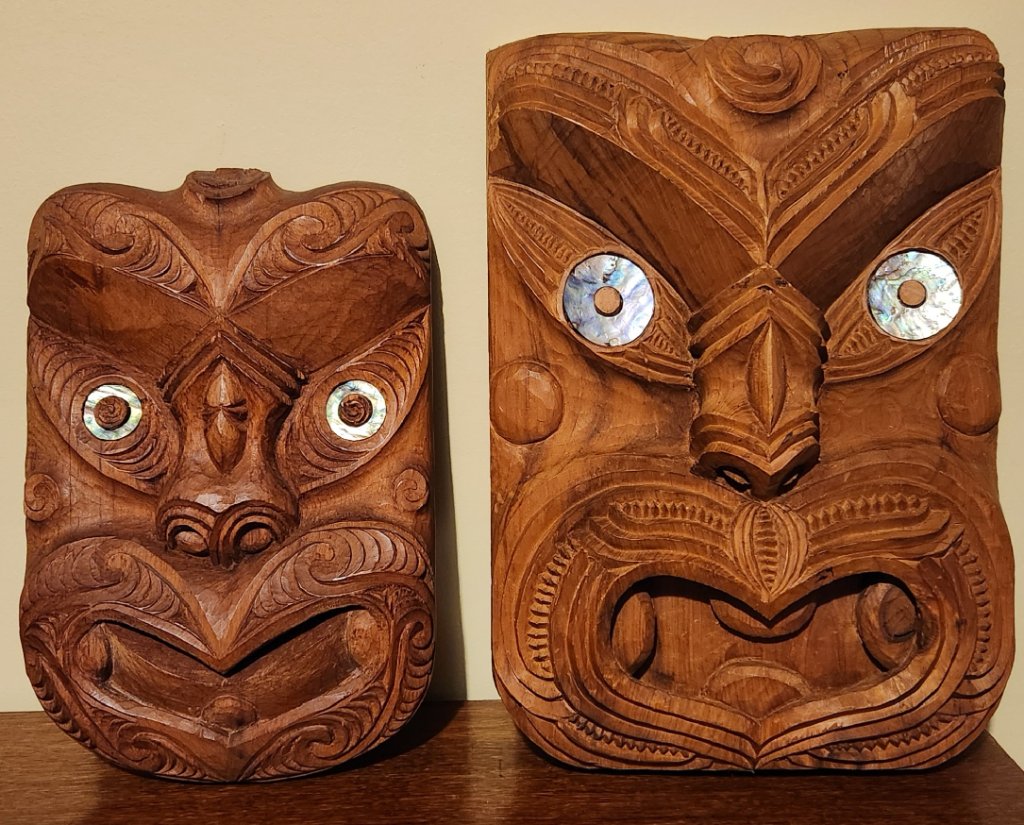
Created during my transformative years of study at Te Wānanga o Raukawa, this collection represents a deep academic and physical exploration into the distinct tribal design parameters of Aotearoa. Under the guidance of my masters, I moved past generalized patterns to study how regional identities are structurally coded into the timber. By intentionally contrasting the rolling, fluid power of West Coast traditions with the strict, voluminous carving principles passed down through East Coast lineages, these works serve as a physical testament to a period focused heavily on technical refinery, tool control, and honoring the geometric diversity of our ancestors.
Outer Panels
Two vertical poupou panels demonstrating the deep, fluid curvilinear rhythms, serpentine forms, and interlocking surface design characteristic of the West Coast and Taranaki regional carving schools.
Central Piece
A central wheku mask showcasing the robust, symmetrical facial geometry, deep brow lines, and structural volume pioneered by the master carvers of the East Coast regions of Aotearoa.
Acknowledgements and Inspirations
West Coast Inspiration
I wish to explicitly acknowledge the ancestral master carvers of the West Coast and Taranaki regional iwi. Their unique ability to weave interlocking, serpentine lines and manipulate fluid negative spaces served as the direct learning inspiration for the outer poupou. Studying their design properties taught me how to capture movement and continuous flow within a vertical timber frame.
East Coast Inspiration
I extend a deep acknowledgment to the master carvers of the East Coast regions of Aotearoa, whose historic schools of whakairo provided the direct inspiration for the central wheku. Their mastery over bold facial proportions, sharp symmetry, and volumetric weight taught me how to carve with a presence that demands respect, directly honoring the structural parameters they perfected over generations.
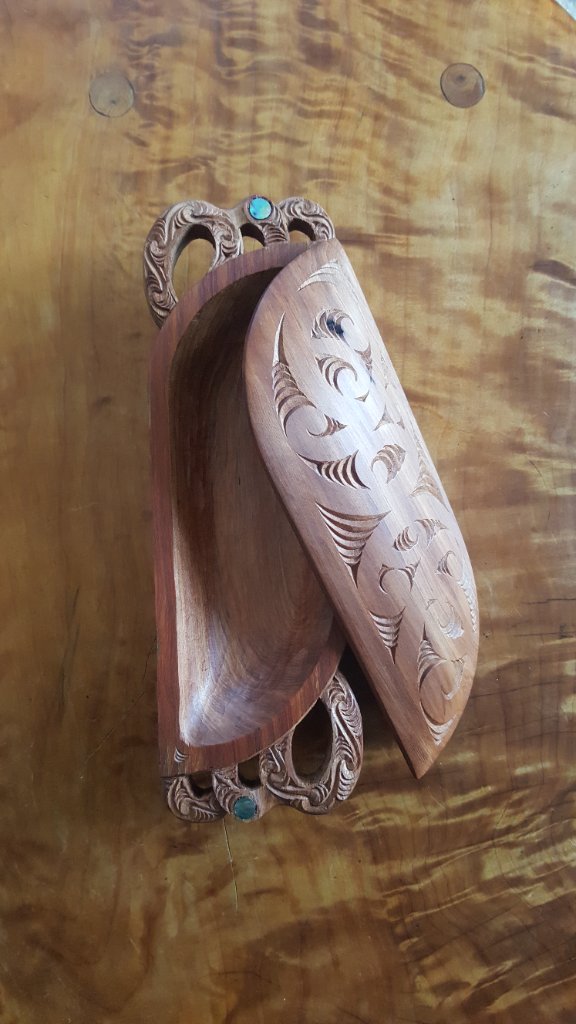
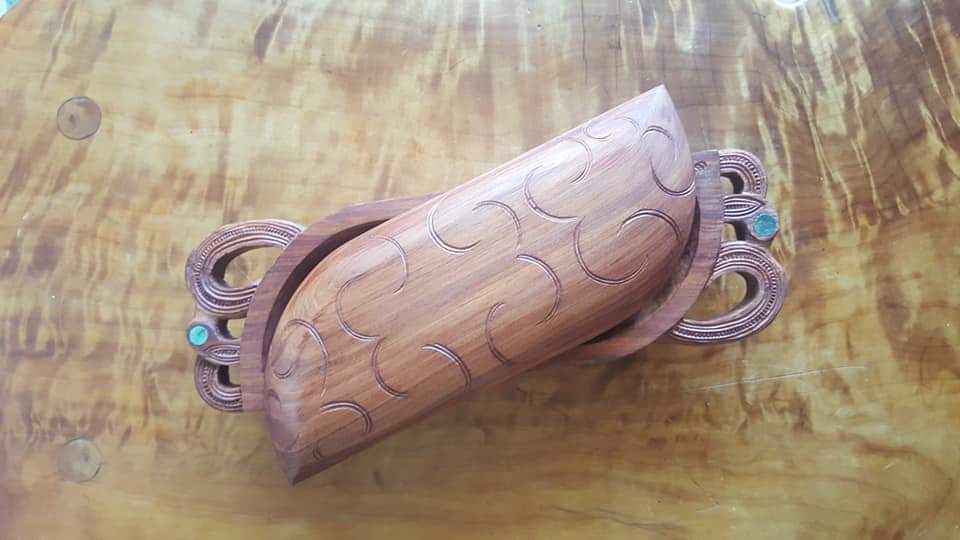
Waka Huia: Pillars of Lineage
Medium
Whakairo rākau (Hand-carved tōtara timber with pāua shell inlay)
Year
2020
Created At
Exhibited at Toi Matarau Art Gallery, Ōtaki (2020)
Guidance
All master teachers of the artist's lineage
Carved during an epic, transformative turn in my life, these waka huia represent the ultimate synthesis of my artistic journey. Fashioned entirely from tōtara, the engineering and surface execution of these wakahuia are a direct reflection of my arts lineage. By listening to the natural grain of the wood, balancing the volume of the curved lids, and anchoring the handles in strict traditional parameters, these contemporary vessels celebrate the endurance of our custom arts. Exhibiting them locally at Toi Matarau stands as a milestone of accountability to the people, the land, and the masters who defined my path.
Waka Huia Form
Two custom-fashioned waka huia utilizing an innovative, off-center pivoting lid closure that fluidly follows the natural, organic sweep of the timber.
Surface Application
Crisply executed surface iconography including Koiri and Raperape on one and Pakati haehae on the other.
Acknowledgements and Inspirations
Ka mihi ahau ki te Kaihanga. First and foremost, I offer my humblest thanks to the Creator for granting me the strength, vision, and guidance to fulfill this work. All my artworks are dedicated to the Creator.
Ki ōku mātua, to my parents, I offer my deepest love and appreciation. Thank you for your unwavering support, your sacrifices, and for nurturing the foundation that allowed me to pursue this path.
Ka mihi hoki ki ngā tohunga whakairo o nanahi, o ināianei hoki. I formally acknowledge the master carvers of both the past and the present who paved this sacred path. Their enduring legacy guides my hands today, and I am truly thankful for the visual and spiritual blueprint they set.
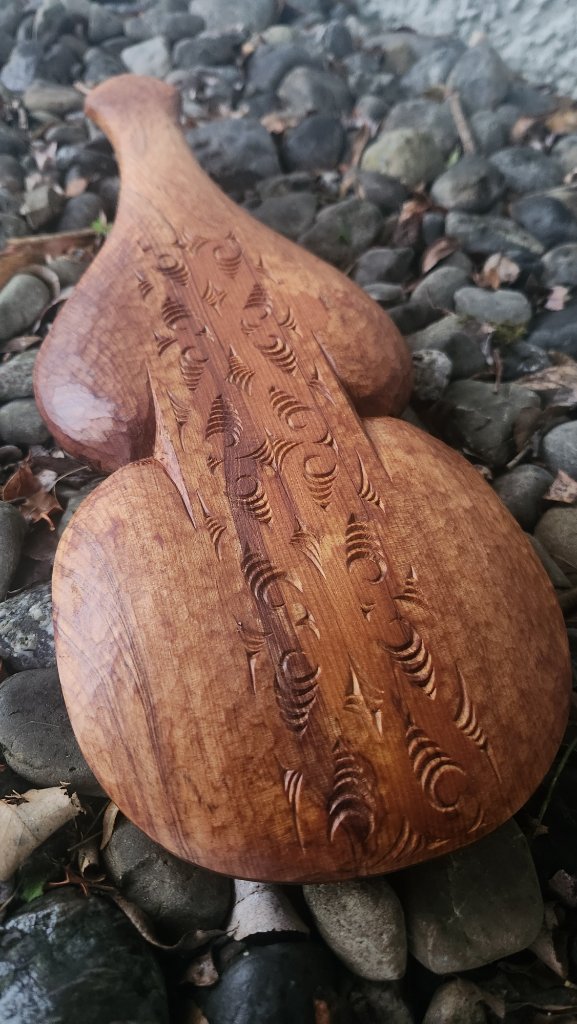
Kotiate
Medium
Whakairo rākau (Hand-carved timber kotiate)
Year
2025
Created At
Guidance
Inspired by the ancestral Apanui kotiate (Te Papa Collection)
Carved in 2025, this kotiate represents a contemporary study in ancestral form and surface iconography. The Pātiki surface design — drawn from the traditional kōwhaiwhai pattern family — was applied across the central blade body in strict, rhythmic rows, honoring the geometric discipline of our tūpuna. The form itself was directly inspired by 'Apanui', the historic kotiate presented by King Tāwhiao to Sir Walter Lawry Buller in 1883, now held in the Te Papa collection. By engaging directly with this ancestral taonga as a design reference, this piece stands as a tribute to the endurance of our customary weaponry traditions and the living dialogue between historic master carvers and contemporary practice.
Surface Application
The surface design on this kotiate is inspired from the traditional kōwhaiwhai design called Pātiki — repeating, symmetrical geometric motifs arranged in vertical, parallel rows running down the centre of the blade body.
Acknowledgements and Inspirations
Ka mihi ahau ki te Kaihanga. My first thanks go to the Creator for the strength, insight, and guidance that shaped this work. All my artistry is dedicated to the Creator. Ki ōku mātua, to my parents, thank you for your deep love, sacrifices, and constant support that allowed me to walk this artistic path. Ka mihi hoki ki ngā tohunga whakairo o nanahi, o ināianei hoki. I acknowledge the master carvers of the past and present who opened this sacred way. Their enduring legacy directly guides my hands, and I hold immense gratitude for the visual and spiritual blueprint they left behind.
Artist Statement
I am an artist whose practice is anchored in the direct transmission of indigenous knowledge—a living link in a chain of practitioners stretching from the ancestral shores of Tahiti to the marae of Aotearoa. My creative foundations were laid at home by my mother, a master weaver and descendant of the Mauatua line, and my father, a profound historian who carved ancient pūrākau and whakapapa into my mind long before I ever held a chisel. This deep historical lens was refined through the raw, physical cuts of whakairo taught to me in my youth by Tohunga Whakairo Matua Lou Kereopa, forged into rigorous professional discipline under Rangi Kipa, and elevated into intellectual design theory by Hēmi Te Peeti. Later grounded in the architectural form and technical refinement of Matua Frazer Taiapa and Tākuta Ferris Jnr, my contemporary work is a collaboration with the natural grain of the timber and canvas. By weaving ancestral narratives, tribal proverbs, and strict technical execution, my art refuses to be a static artifact of the past; it is an aggressive, living language designed to project the enduring mana, presence, and sovereignty of our people.